renshuu - Japanese learning
- 4.9
- Rating
- 1.00M
- Installs
- Free
- Price

 Analysis by App-foxy
I approached renshuu as a Japanese-learning tool I could keep opening after the first burst of enthusiasm had passed. That matters because many study apps feel excellent during the first week, then become another icon on the phone. This one made a better early impression than most, mainly because it treats Japanese as a collection of connected skills rather than a single stream of flashcards. I could move between vocabulary, kanji, grammar, and review without feeling that I had to rebuild my study plan every time I changed focus.
Developed by renshuu.org, this free education app is aimed at learners who want a personal route through Japanese instead of a rigid course that decides every next step. It is available to Everyone, runs on Android from version 7.1 onward, and its current version is 1.2.20260311. The headline appeal is simple: there are no ads, paywalls, or timers interrupting ordinary study. In practice, I found the more important benefit was the calmer rhythm. I could study for a few minutes without being pushed into a race.
Why the first week feels unusually easy to start
My first week with renshuu was less about completing a dramatic lesson path and more about discovering how much control the app gives the learner. That freedom can be refreshing if I already know whether I want to work on kana, kanji, vocabulary, or grammar. Instead of treating every learner as a complete beginner, it lets the experience feel more personal from the beginning.
You May Also Like

 Blood Strike: 2.5 Anniversary
Blood Strike’s Loadouts Turn Every Drop Into a Tactical Gamble
A close look at Blood Strike’s custom loadouts: how fast access to signature weapons reshapes its battle royale rhythm, rewards preparation, and narrows the gap between fights.

 Pandora - Music & Podcasts
Pandora’s Music Is Easy to Start, but Harder to Recover
Pandora’s strength is its low-effort path from a seed to a station. Its weak spot is how much confidence it asks you to place in connection, setup, and quiet recovery.

 8 Ball Pool
 Is Built on Rivalries, Rematches, and Routine
A close look at the rivalries, rematches, shared routines, and unanswered safety questions that turn a quick pool match into a persistent mobile community.

 Samsung Music
’s Quiet Strength Is Playing What You Already Own
Its reach comes less from spectacle than from dependable access to a personal library. That simplicity is both the app’s strongest retention engine and its ceiling.

 AccuWeather: Weather Radar
AccuWeather Review: A Quick, Clear Forecast for Everyday Decisions
For everyday plans, the best forecast is the one you can understand quickly. AccuWeather makes rain timing, radar, and local conditions easy to act on, with a few trade-offs.

 Hill Climb Racing
Why Hill Climb Racing Still Turns Crashes Into One More Run
A tiny car, a bumpy hill and one more upgrade: Hill Climb Racing keeps resurfacing because its simple chaos makes every near-miss feel personal.
More From Our News Desk



That flexibility is also the first thing I would warn new users about. A completely new learner may open the app expecting one obvious “start here” button and find more choices than expected. I recommend resisting the urge to add everything immediately. Pick one practical target, such as recognizing basic kana or building a small everyday vocabulary, then let the review system establish a routine before exploring every available area.
The lack of advertising makes a noticeable difference during short sessions. I could open the app while waiting for a kettle to boil, complete a small amount of practice, and leave without being diverted by promotional screens. The store describes the experience as free of ads, paywalls, and timers, and that promise matches the way the app feels during normal use. Optional purchases are available, ranging from $3.99 to $129.99 per item, so users should still look at the purchase choices carefully before spending. The free starting experience is the main reason I think it is worth trying first.
What I liked most was the possibility of turning a vague goal into a repeatable habit. “Learn Japanese” is too broad to guide a busy day. A narrower intention, such as recognizing signs, reading simple menus, or understanding common phrases in games, gives each session a reason. renshuu works better when I bring that intention to it rather than waiting for the app to create motivation from nothing.
For someone coming from a traditional textbook, the transition is fairly comfortable because the material can be approached in small pieces. For someone used to a heavily scripted language app, the experience may initially feel less theatrical. There is less of the constant reward-show feeling that some mainstream alternatives use. I saw that as a strength once I settled in, but users who need bright animations and a tightly narrated course may find the first sessions quieter than expected.
A practical setup for the opening days
I would begin with one core study area and a modest daily commitment. The goal is not to prove that I can survive a long session; it is to make tomorrow’s session easy to begin. Keeping the first routine short also reveals whether the review style suits me before I invest serious time in organizing a larger plan.
A useful trick is to separate recognition from production in my expectations. Recognizing a word when I see it is not the same as recalling it while speaking or writing. renshuu can support steady exposure and review, but it cannot remove the need to say Japanese aloud or create my own sentences. I found that pairing an app session with a few minutes of reading or listening made the learned items feel less isolated.
Another non-obvious advantage is that the app can function as a decision filter. If I keep postponing grammar because I only enjoy vocabulary practice, that tells me something about my study balance. If kanji reviews repeatedly drain my attention, I can shorten that part rather than abandoning Japanese altogether. The ability to adjust the route is valuable, but it also means I remain responsible for noticing gaps.
What remains useful after the novelty fades
After the first month, the question changes from “Is this fun?” to “Does opening it still improve my Japanese?” My answer is yes, provided I use it as a maintenance system rather than expecting it to be a complete substitute for real language contact. Its recurring value comes from giving me a place to revisit material that would otherwise disappear from memory.
That is especially useful for vocabulary and kanji, where the problem is rarely seeing an item once. The real problem is meeting it again at the right time, after the initial recognition has weakened but before it vanishes completely. A review-centered routine gives those items repeated attention. I still needed outside reading and listening to understand how words behave in context, but the app helped keep the building blocks available.
For busy learners, this makes renshuu more sustainable than a course that demands a fixed uninterrupted block. I could use a longer session on a quiet evening, then return for a smaller maintenance session on a crowded day. That flexibility is more realistic than pretending every week will have the same schedule. It also reduces the guilt that often causes people to quit after missing a study day.
The app’s personal-path approach is a good match for learners whose goals change. I might begin with travel Japanese, shift toward reading, and later become more interested in grammar. A fixed beginner course can become awkward when the learner’s priorities move. Here, the route can adapt, although adaptation requires me to make sensible choices rather than simply follow a predetermined road.
I also think renshuu has lasting value for people who have already tried several beginner resources and want a central review space. It does not force me to restart from the beginning just because I know some material. That can save time and make the app feel more respectful of previous study. At the same time, a returning learner should audit their confidence honestly. Familiar-looking cards can create the illusion of mastery if I recognize the answer but cannot recall it independently.
Where it fits beside textbooks and other language apps
Compared with a textbook, renshuu is more convenient for frequent review and easier to fit into spare moments. A textbook is usually better at presenting a carefully sequenced explanation, extended dialogues, and a sense of chapter-level progress. I would not replace a good reference book with the app if my main weakness were understanding detailed grammar explanations.
Compared with a typical gamified language app, renshuu feels less dependent on streak pressure and timed performance. That makes it a better fit for someone who wants a calmer study relationship. The trade-off is that the learner may receive less emotional momentum from constant rewards. If external pressure is the only thing that gets me to study, I might find the experience too self-directed.
Compared with a dictionary, it is more useful for building a repeated learning routine, but a dictionary remains better when I need a quick definition, example, reading, or usage check for a specific word. I see renshuu as the place where items become study targets, not as the only tool I need whenever I encounter Japanese in the wild.
Compared with private tutoring or conversation practice, the app is obviously more affordable at the free entry point and easier to use alone. It cannot notice that my pronunciation sounds unnatural, respond naturally to an unexpected question, or correct a conversation in the same way a skilled teacher can. Learners whose priority is speaking confidence should treat it as preparation, not the entire solution.
Small workflows that make the routine stronger
My most effective workflow was to use the app for deliberate review, then immediately connect the session to something outside it. After studying a group of words, I would look for them in a short Japanese text or listen for them in familiar media. This exposed a useful limitation: knowing a flashcard answer is only the first layer. Context reveals different readings, politeness levels, and words that are technically familiar but still slow to recognize.
A second useful workflow is to give each study area a job. Vocabulary can support reading, kanji can support visual recognition, and grammar can explain relationships between words. When every category is treated as a competition for the same daily attention, the routine becomes tiring. When each one serves a specific purpose, it becomes easier to decide what to skip on a busy day without feeling that the whole plan has failed.
A third insight is that flexibility should not become endless customization. I noticed that planning can feel productive while replacing actual study. I would set up a simple route, use it for several days, and only then change it if the workload or content clearly felt wrong. This kept the app from becoming a project-management hobby.
For a traveler, I would use it differently than for an anime fan or a long-term reader. A traveler may prioritize practical vocabulary and recognition of common signs, while a reader may accept slower progress in exchange for deeper kanji and grammar work. The same app can serve both, but the learner has to decide which outcome matters most. Its personal approach is not magic; it is a framework that rewards clear goals.
The maintenance burden is low, but not zero
The main maintenance burden is not technical. It is attention. Because renshuu does not rely heavily on ads, timers, or aggressive pressure, I have to remember why I am opening it. That is healthier for many learners, but it means the app cannot carry the entire habit by itself. A calendar reminder, a fixed after-breakfast routine, or a connection to another Japanese activity may be necessary.
There is also a mental burden in choosing what to study. Beginners may appreciate guidance but feel uncertain when faced with multiple possible directions. My advice is to choose a narrow starting lane and postpone optimization. The best plan is the one I can follow repeatedly, not the one that appears most complete on paper.
Review can become demanding as the collection grows. A large backlog is discouraging, especially if I treat every due item as an obligation that must be cleared in one sitting. I found it better to accept smaller sessions and let the routine recover gradually. Missing a day should not become a reason to turn the next session into punishment.
Another limitation is that independent study can hide weak areas. I may keep selecting material I enjoy and quietly avoid the grammar or listening practice I need. The personal route is excellent for ownership, but it can also reinforce preferences. Every few weeks, I would check whether my chosen activities still match my real goal rather than my easiest habit.
Device compatibility is approachable for older Android users because the minimum requirement is Android 7.1, but compatibility alone does not decide whether the experience feels comfortable on a particular device. Screen size, typing comfort, and notification habits can affect how pleasant repeated study becomes. I would test a normal week of use before committing to a large paid option.
What causes fatigue over time
The first source of fatigue is repetition without context. Even a well-designed review routine can begin to feel mechanical when every session consists only of recognizing isolated items. I avoided that by treating reviews as preparation for reading, listening, and writing rather than as the final destination.
The second is the tension between breadth and depth. It is tempting to collect more vocabulary, more kanji, and more grammar points because the app makes exploration easy. But every new target creates future maintenance. Adding material feels exciting today while increasing tomorrow’s workload. I would rather build a smaller, dependable base than create an impressive list I cannot revisit.
The third is the absence of a teacher’s external perspective. When I study alone, I can mistake persistence for accuracy. The app can help me remember material, but I still need authentic input and occasional feedback to discover pronunciation, phrasing, and comprehension problems. This is the clearest reason I would not recommend using it as the only Japanese resource.
Some learners may also miss a strong narrative. A textbook chapter tells me where I am and what comes next. A heavily gamified app tells me that I have completed a level. renshuu’s quieter, more adjustable structure gives me freedom but less of that ready-made story. If visible milestones are central to my motivation, I may need to create my own checkpoints, such as reading a short text or understanding a familiar dialogue.
Still, I prefer these limitations to the fatigue caused by constant interruptions or pressure. The app’s lack of ads and timers leaves room for a more sustainable relationship with study. Its challenge is not that it demands too much time; it is that it asks me to use my time intentionally.
My long-term verdict
renshuu earns lasting space on my phone because its value is strongest after novelty fades. It gives Japanese learners a practical place to maintain vocabulary, kanji, and grammar while allowing the route to change with their goals. The free price makes experimentation easy, and the absence of ads, paywalls, and timers makes short, repeatable sessions pleasant rather than stressful.
Its reputation is strong: the app has a 4.9 average from around 15 thousand ratings, with more than a thousand written reviews and over a million installs. Those figures do not replace personal fit, but they match my impression that this is a mature choice for learners who want control and consistency.
I would recommend it to a self-directed beginner who is willing to make a simple plan, to an intermediate learner who needs dependable review, and to anyone tired of apps that confuse entertainment with progress. I would be more cautious with someone who wants a fully scripted course, detailed teacher-style explanations at every step, or immediate conversation practice. Those learners may get better results by pairing it with a textbook, tutor, dictionary, or regular listening routine.
The most important trade-off is straightforward: renshuu gives me freedom, but freedom requires a little discipline. If I use that freedom to keep sessions realistic, connect reviews to real Japanese, and resist adding more material than I can maintain, the app remains useful month after month. If I expect it to provide motivation, context, speaking feedback, and a complete curriculum without any decisions from me, the experience will eventually feel incomplete.
For my own routine, that balance is worthwhile. I would keep it as the dependable review center of a broader Japanese habit, not as the whole habit. That is exactly why it lasts: it handles the recurring work well, leaves space for real-world practice, and does not demand that every study session become a performance.
FAQs for renshuu - Japanese learning
01What is renshuu, and who is it designed for?
renshuu is a Japanese-learning app designed for complete beginners, intermediate learners, and more advanced students who want structured practice in vocabulary, kanji, grammar, and listening. During testing, its lessons felt flexible rather than limited to one rigid course. You can choose guided learning paths or focus on specific skills, making it suitable for casual learners as well as people preparing for JLPT-style study.
02What can I learn with renshuu?
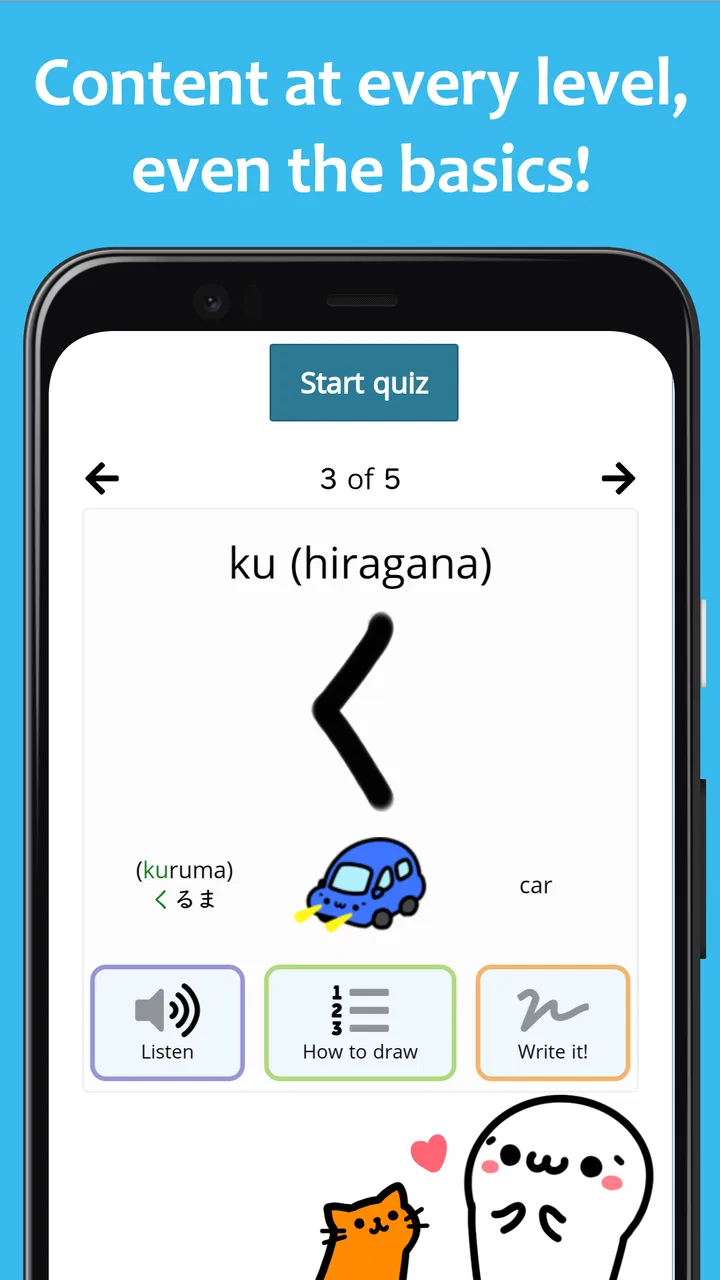
The app covers many important areas of Japanese, including hiragana, katakana, kanji, vocabulary, grammar, sentence patterns, and listening practice. It also includes themed word lists and review activities that help connect individual terms with practical usage. This broad selection makes renshuu useful for building a balanced study routine instead of relying only on flashcards or isolated kanji memorization.
03Does renshuu use spaced repetition for reviews?
Yes, renshuu uses review scheduling to help you revisit words, kanji, and other material at appropriate intervals. This is one of its most useful features because it reduces the need to decide manually what to study each day. The app tracks your progress and brings back difficult items more often, while familiar material gradually appears less frequently, supporting long-term retention.
04Is renshuu free to download, and are there paid features?
renshuu can be downloaded and used without paying, and the free experience provides access to a substantial amount of learning content. However, some advanced tools, customization options, courses, or convenience features may require a premium subscription or purchase, depending on the current app offering. It is worth checking the in-app pricing and feature comparison before subscribing, especially if you only need basic vocabulary and review practice.
05Can renshuu be used offline or without an internet connection?
Some study functions may remain available offline after the necessary content has been loaded, but the exact offline experience can depend on the lesson, media type, and device. Features involving synchronization, online resources, updates, or certain audio and community content may require an internet connection. If you plan to study while traveling, open your selected materials beforehand and test them in offline mode.
Pros
- Clear learning paths for beginners through advanced Japanese students.
- Excellent kanji
- vocabulary
- and grammar practice variety.
- Spaced repetition helps reinforce difficult words over time.
- Useful sentence examples provide context beyond simple translations.
- Progress tracking and daily goals encourage consistent study.
Cons
- The large number of features may feel overwhelming at first.
- Some advanced content and tools require a paid subscription.
- Explanations can be brief for learners needing deeper grammar detail.
- Notifications and reminders may become repetitive during daily use.
- Internet access may be needed for some audio and content features.

renshuu - Japanese learning
Gallery